Enterprise Resource Planning Tools for Managing Finance, HR, and Operations
Managing different areas of a business can become increasingly difficult as a company grows. Finance teams need accurate financial records, HR needs to manage employee information, and operations teams need to keep daily processes running smoothly. When these functions rely on separate systems, important information can become scattered and difficult to manage.

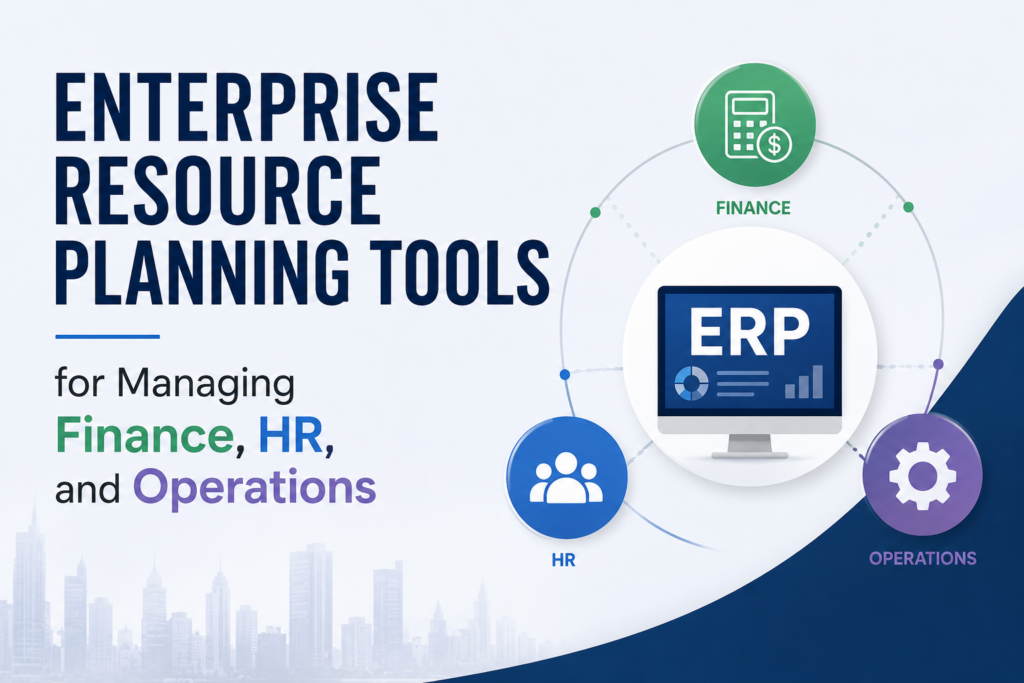
Enterprise Resource Planning (ERP) tools bring these business functions together in one centralized platform. By connecting financial management, human resources, inventory, procurement, operations, and other processes, ERP systems can give businesses a clearer view of their overall performance.
What Are Enterprise Resource Planning Tools?
Enterprise Resource Planning tools are software platforms designed to manage and connect core business processes. Instead of maintaining separate systems for accounting, employee management, purchasing, and operations, businesses can use an ERP platform to manage these functions within an integrated environment.
ERP tools typically use a shared database, allowing information entered by one department to become available to other authorized teams. For example, when a purchase is recorded by the procurement team, the relevant financial information can also be reflected in the accounting system.
This integration reduces repetitive data entry and helps businesses maintain more consistent information across departments.
How ERP Tools Help Manage Finance
Financial management is one of the most common uses of ERP software. Businesses can use ERP systems to centralize financial information and automate many routine accounting processes.
Common financial capabilities include:
- General ledger management
- Accounts payable and receivable
- Expense tracking
- Budgeting and forecasting
- Financial reporting
- Invoicing
- Tax management
- Cash flow monitoring
With financial information stored in one system, accounting teams can spend less time gathering data from different departments. Automated reports can also make it easier for managers to understand revenue, expenses, cash flow, and other financial indicators.
ERP systems can also improve financial visibility by connecting transactions with other business activities. For example, finance teams may be able to see how inventory purchases, employee costs, and sales activities affect the company’s overall financial position.
Using ERP Tools for Human Resources
Human resources departments manage a large amount of employee-related information. Managing this information through spreadsheets and disconnected applications can create unnecessary administrative work.
ERP tools with HR capabilities can centralize information such as:
- Employee profiles
- Payroll
- Attendance and time tracking
- Benefits
- Leave management
- Recruitment information
- Performance records
- Training data
Centralized HR data makes it easier for employees and managers to access relevant information while reducing the need for HR teams to maintain multiple records.
For example, employee attendance data can be connected with payroll processes, helping reduce manual calculations and the possibility of data-entry errors.
Streamlining Business Operations
ERP systems can also help businesses coordinate their day-to-day operations. Depending on the platform and industry, operational modules may cover inventory, purchasing, supply chain management, manufacturing, order management, and project management.
Businesses can use these tools to monitor:
- Inventory levels
- Purchase orders
- Supplier information
- Customer orders
- Production schedules
- Project costs
- Supply chain activities
Having this information connected allows teams to make decisions using a broader view of business activity. An operations manager, for instance, can review inventory levels alongside purchasing information and customer demand rather than relying on separate spreadsheets.
Connecting Finance, HR, and Operations
One of the biggest advantages of an ERP platform is the connection between departments.
Consider a company that is preparing to expand its operations. The finance team needs to understand the cost of hiring additional employees, HR needs to manage recruitment and payroll, and the operations team needs to plan resources and purchasing.
With disconnected systems, each department may work with different data. An ERP platform can connect these processes so that relevant information flows between departments.
This creates a more coordinated workflow and gives management a more complete picture of how operational decisions affect the company’s finances and workforce.
Key Benefits of Enterprise Resource Planning Tools
1. Centralized Information
ERP software provides a central location for important business data. Employees can work with consistent information instead of maintaining separate departmental records.
2. Reduced Manual Work
Automation can handle repetitive activities such as invoice processing, payroll calculations, reporting, and inventory updates. This allows employees to focus on tasks that require more attention.
3. Better Decision-Making
Managers can use real-time or regularly updated information to evaluate business performance. Integrated reporting can make it easier to identify trends and potential problems.
4. Improved Collaboration
When departments have access to relevant shared information, collaboration becomes easier. Finance, HR, sales, and operations can work from the same underlying data.
5. Greater Operational Visibility
ERP tools can provide dashboards and reports that help businesses monitor key activities across multiple departments.
How to Choose the Right ERP Tool
Not every ERP platform is suitable for every business. Companies should consider their size, industry, existing processes, budget, and future growth plans before selecting a solution.
Start by identifying the business processes that need improvement. A company may primarily need stronger financial management, while another may require better inventory, HR, or supply chain capabilities.
Businesses should also evaluate:
- Available features and modules
- Integration capabilities
- Ease of use
- Scalability
- Data security
- Reporting capabilities
- Implementation requirements
- Customer support
- Total cost of ownership
It is also important to consider how the ERP system will integrate with existing software. For example, a business may already use Customer Service Tracking Software and want to ensure that customer information and support activities can work alongside its ERP system.
Enterprise Resource Planning tools can help businesses bring finance, HR, and operations into a more connected environment. By centralizing information and automating routine processes, ERP systems can reduce administrative work while giving managers better visibility into business performance.
The right ERP solution should not simply add another layer of software. It should address existing operational challenges, connect important workflows, and provide the flexibility a business needs as it grows. Careful evaluation of features, integrations, usability, and long-term costs can help businesses choose an ERP platform that supports their broader goals.