Making Tax Digital for Income Tax 2026/27: MTD Quarterly Submissions Explained
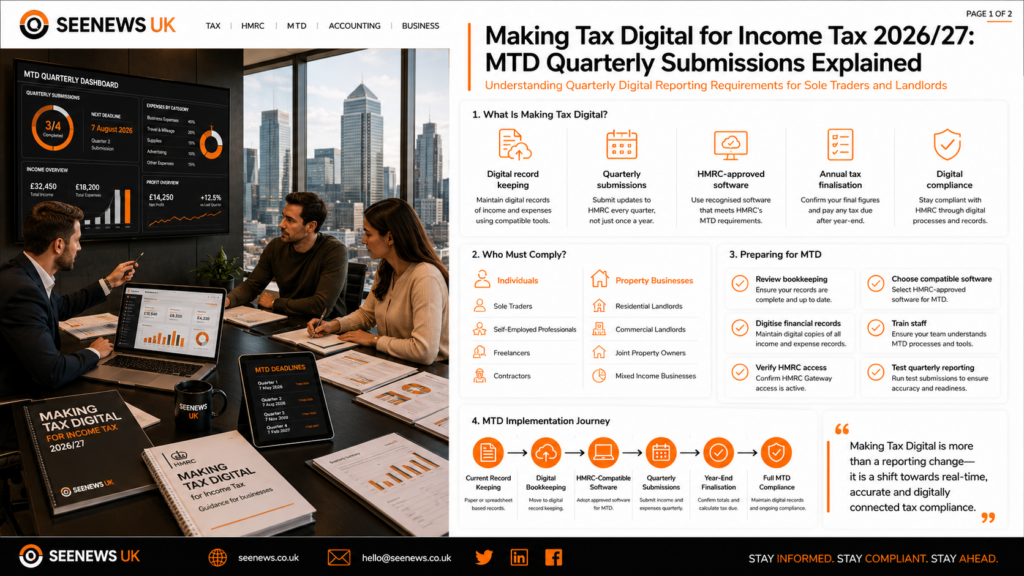
If you’re self-employed or earn rental income in the UK, you’ve probably heard the term floating around by now. Making Tax Digital for Income Tax 2026/27 is the biggest shake-up to Self Assessment in decades, and it’s already started for the first wave of taxpayers. Instead of filing one annual tax return, you’ll be submitting updates roughly every three months, using approved software rather than a spreadsheet you’ve patched together over the years.

This isn’t just a new form to fill in. It changes how you keep records day to day, what software you need, and how often HMRC expects to hear from you. The earlier you understand what’s actually required, the less stressful the switch becomes.
Quick answer: MTD for Income Tax requires sole traders and landlords earning over £50,000 to keep digital records and submit quarterly updates from 6 April 2026, replacing the old single annual return with four updates plus a year-end declaration.
What Is Making Tax Digital for Income Tax, Really?
Think of it as HMRC swapping one big annual snapshot for four smaller check-ins throughout the year. Instead of tallying everything up in January, you report income and expenses roughly every quarter as you go.
HMRC’s reasoning makes sense once you see it from their side. Annual returns leave a lot of room for mistakes, forgotten receipts, and guesswork months after the fact. Quarterly reporting, built on digital records, aims to close that gap and give both you and HMRC a clearer picture of where things stand throughout the year.
Key takeaway: MTD doesn’t replace your tax bill or how tax is calculated it replaces how and when you report the numbers behind it.
Who Actually Needs to Comply?
This is where a lot of confusion creeps in, so let’s clear it up properly.
If your gross income from self-employment or property was more than £50,000 on your 2024/25 tax return, you’re in scope from 6 April 2026. That threshold drops to £30,000 from April 2027, then £20,000 from April 2028, gradually pulling in more taxpayers each year.
A crucial detail people miss: this is based on gross income, not profit. A landlord collecting £55,000 in rent but only clearing £15,000 after mortgage interest and expenses still falls inside MTD. Turnover triggers it, not take-home.
Employment income, dividends, and pension income don’t count toward the threshold at all; only self-employment and property income do. And if you’re a partner in a partnership, that partnership itself still files its usual SA800 return; MTD only applies to any separate self-employment or property income you personally have outside it.
Key takeaway: Check your gross turnover, not your profit, and remember PAYE and dividend income sit outside the calculation entirely.
How Does the Quarterly Process Actually Work?
Rather than one return, you’ll work through a repeating cycle each tax year.
| Stage | What Happens |
| Digital record keeping | Ongoing, throughout each quarter |
| Quarterly updates (x4) | Summary of income and expenses, submitted via software |
| End of Period Statement (EOPS) | Confirms final figures for each business, submitted after year-end |
| Final Declaration | Replaces the old tax return, due by 31 January |
Each quarterly update isn’t a tax return in miniature.it’s simply a summary pulled from your digital records. The real reconciling and tax calculation still happens at year-end through the Final Declaration, same deadline as always: 31 January.
Can You Still Use a Spreadsheet?
Technically, yes but only if it connects to HMRC-approved bridging software. A standalone spreadsheet with no digital link to submit data won’t cut it on its own anymore.
| Option | Pros | Cons |
| Spreadsheet + bridging software | Familiar, low cost | Manual entry risk, extra software layer |
| Full accounting software | Automated, bank feeds, fewer errors | Learning curve, subscription cost |
For anyone juggling multiple income streams, proper accounting software tends to save more time than it costs, mainly because bank feeds and automation cut down the manual entry that spreadsheets demand.
What Happens If You Miss a Deadline?
HMRC now uses a points-based penalty system rather than an instant fine. Miss a quarterly update or the Final Declaration, and you pick up one point. Hit four points, and a £200 fine follows.
There’s a bit of breathing room for the very first wave, though HMRC has confirmed a penalty easement for the initial four quarterly updates from taxpayers starting in April 2026, meaning no points accrue during that settling-in period. That easement won’t apply to people joining from 2027 or 2028, so don’t assume it’ll always be there.
Common Mistakes Worth Avoiding Early
A lot of people wait until the deadline is right on top of them before touching their bookkeeping, and that’s usually when things go wrong. Mixing personal and business expenses in the same account causes headaches every single quarter, not just once a year like it used to.
Missing receipts is another quiet problem.it’s far easier to lose track of a coffee-shop meeting or a small tool purchase when you’re reconciling every three months instead of doing one big annual sweep. And plenty of people assume quarterly updates calculate their tax automatically. They don’t. The real number only comes together at the Final Declaration stage.
Myth vs Fact
Myth: MTD means paying tax four times a year.
Fact: You’re reporting four times a year payment deadlines haven’t changed.
Myth: Everyone earning any income must comply from April 2026.
Fact: Only those over £50,000 gross income are mandated this year; the threshold lowers gradually.
Myth: Accountants become unnecessary once software does the reporting.
Fact: Software handles submissions.it doesn’t replace judgment on allowable expenses, reliefs, or year-end accuracy.
Getting Ready: A Short Practical Checklist
- Confirm your gross income against the current threshold
- Separate business and personal banking now, not later
- Choose MTD-compatible software and connect your bank feed
- Build a simple weekly habit for logging income and expenses
- Sign up with HMRC before your first submission is due

Frequently Asked Questions
Do I need to sign up for MTD myself, or will HMRC do it automatically?
You need to sign up yourself. HMRC won’t do this for you. If your gross income exceeds the relevant threshold, you have to register on GOV.UK before your first submission is due. Leaving it too close to the deadline risks missing your first quarterly update, so it’s worth sorting early rather than waiting for a reminder that isn’t coming.
What if my income changes partway through the year and I go over the threshold?
Your MTD status is actually based on the gross income reported on your tax return for the year before, not what you’re earning right now. So if you’re just over £50,000 this year, it won’t pull you into MTD until a future tax year, based on that return. It’s worth checking each year though, since crossing the threshold once usually means you’ll need to keep complying going forward.
Can my accountant handle the quarterly updates for me?
Yes, and for a lot of people this ends up being the simplest route. Accountants and agents can be authorised to submit quarterly updates and the Final Declaration on your behalf through MTD-compatible software. You’ll still need to keep your records organised and share them regularly, but the actual submissions can sit with them.
What happens if I stop trading partway through the year?
You’ll still need to submit quarterly updates covering the period you were trading, along with a final EOPS and Final Declaration to close things off properly. MTD doesn’t just stop the moment you decide to wind down HMRC still needs the full picture for the tax year in question.
If I have both rental income and a self-employed business, do I need to report them separately?
Yes. MTD submissions are made on a per-business basis, even though the £50,000 threshold itself is calculated on your total gross income across everything combined. In practice, that means separate digital records and separate quarterly updates for your property income and your self-employment income, even though it’s all sitting under one tax return at year-end.
Here you can read our another blog: London Quadrant Housing Trust Regulatory Judgement 2025/26
Final Thought
MTD rewards people who start early and dread it a lot more if left until the deadline’s staring back at them. Building a steady digital record-keeping habit now makes each quarterly update a five-minute task instead of a scramble.
That’s where Seenews comes in, helping sole traders and landlords set up the right software, connect bank feeds properly, and build solid record-keeping habits before their first submission is due. Getting that groundwork in place early is what turns MTD from a compliance headache into just another routine part of running your business.