How to Write a High-Quality Academic Assignment
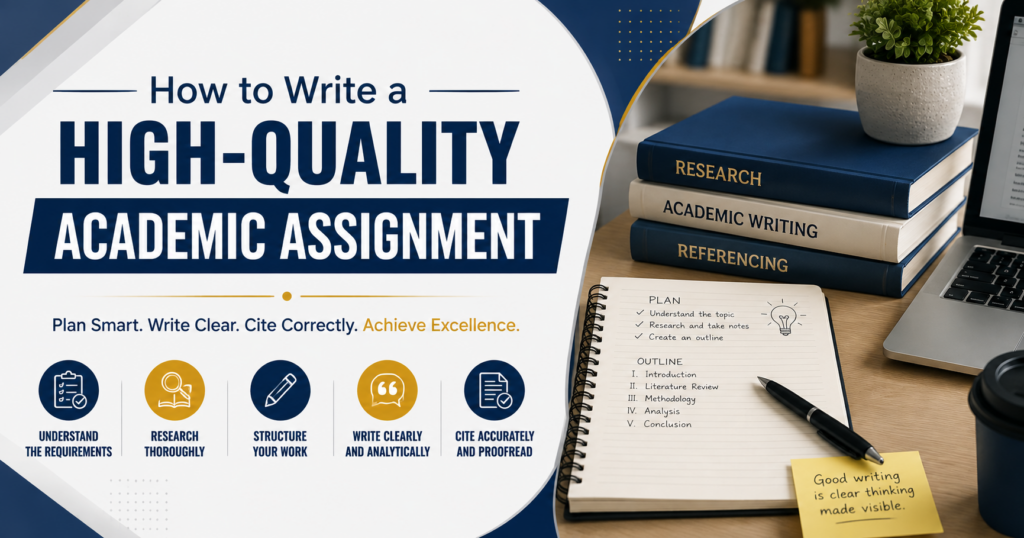
Writing a high-quality academic assignment isn’t just about knowing your subject. Many students lose marks not because their ideas are weak, but because their assignment lacks structure, clarity, or proper referencing. A well-researched argument can still score poorly if it’s disorganized or doesn’t directly answer the question.

This guide walks you through academic assignment writing step by step. It covers everything from understanding the brief to proofreading your final draft. That way, you can consistently produce work that meets academic standards and earns strong grades.
Quality in academic work isn’t a single ingredient. It’s a combination of a clear argument, evidence that supports that argument, and a structure the reader can follow easily. Technical accuracy in referencing and formatting matters too. Miss any one of these, and even a well-researched assignment can fall short of its potential grade. The good news is that each of these elements is learnable. It’s a process you can repeat for every assignment, not a talent some students simply have.
Understand the Assignment Brief First
Before you write a single word, take time to fully understand what’s being asked of you. This step is often rushed, but it’s the foundation of good assignment structure.
Start by reading the question or prompt more than once. Look closely at the instructional words, since they tell you exactly what kind of response is expected:
- Analyze break the topic into parts and examine each one
- Discuss explore different viewpoints or arguments
- Evaluate weigh the strengths and weaknesses of an argument or approach
- Compare identify similarities and differences between ideas or sources
Beyond the instructional words, check the practical requirements too. Confirm the word count, required formatting, referencing style, and submission deadline. Missing these details is an easy way to lose marks before your writing is even assessed.
It also helps to check whether a marking rubric has been provided. Rubrics break down exactly how marks are distributed. They show how much weight is given to argument quality versus referencing versus structure. Reading one before you start writing lets you prioritize your effort where it counts most. If no rubric is available, look back at feedback from previous assignments. Identify patterns in what you tend to lose marks on. Treat those patterns as areas to focus on this time.
Research and Plan Before You Write
Strong assignments are built on solid research and a clear plan, not written on the fly. Skipping this stage usually shows up later as a disorganized or shallow final draft.
Begin by gathering credible academic sources journal articles, textbooks, and reputable databases rather than general web searches. As you read, take structured notes and record where each idea or quote came from. This way, you won’t be scrambling for citations later.
Once you’ve gathered enough material, build a rough outline. Decide on your main argument, the key points that support it, and the order you’ll present them in. This is also where developing strong academic writing skills pays off. The ability to synthesize multiple sources into a coherent argument is what separates average assignments from excellent ones.
A useful habit at this stage is to group your notes by theme rather than by source. If three different authors touch on the same point, cluster those notes together. This makes it easier to write paragraphs that compare and synthesize perspectives. It also beats moving through sources one at a time. Planning this way before you draft also reduces the restructuring you’ll need to do later, saving time overall.
How to Structure Your Assignment
A clear structure makes your argument easier to follow. It also signals to your marker that you understand how to write an assignment properly.
Introduction Your introduction should state the purpose of the assignment and outline your main argument or approach. Keep it focused around 10% of your total word count is a reasonable target. That’s roughly 200 words for a 2,000-word assignment.
Body Paragraphs Each paragraph should focus on a single idea. Start with a clear topic sentence, follow it with supporting evidence, then explain how that evidence supports your overall argument. Use transitions between paragraphs so your ideas flow logically, rather than reading as a list of disconnected facts.
A helpful way to check paragraph quality is to see whether it follows a point–evidence–explanation pattern. State your point, back it up with evidence, then explain why that evidence matters. Paragraphs that only present evidence without explaining its significance tend to read as descriptive rather than analytical. Markers often flag this as a missed opportunity to demonstrate critical thinking.
Conclusion Summarize your key points and restate how they answer the original question. Avoid introducing new information here the conclusion should reinforce what you’ve already argued, not open new threads.
Writing Style and Academic Tone
Academic writing has its own conventions. Getting the tone right is part of what makes an assignment feel polished rather than casual.
Keep your language formal: avoid contractions, slang, and overly conversational phrasing. Aim for clarity and conciseness rather than complex sentences for their own sake. A well-explained simple sentence is more effective than a convoluted one.
Every claim you make should be backed by evidence from credible sources, properly cited. Whichever referencing style your institution requires Harvard, APA, or MLA apply it consistently throughout the entire assignment. Inconsistent referencing is a common and easily avoidable way to lose marks.
Common Mistakes That Lower Assignment Quality
Even strong students fall into these traps, so it’s worth checking your draft against them before submission:
- Weak thesis statements that are too vague or don’t take a clear position
- Poor paragraph structure, with multiple ideas crammed into one paragraph or no clear topic sentences
- Inconsistent or missing citations, which can raise questions about academic integrity
- Not directly answering the question, often because the writer drifts into related but off-topic territory
Reviewing your draft specifically for these issues is one of the fastest ways to improve assignment writing quality. Do this separately from a general read-through for the best results.
It’s worth setting aside a dedicated review pass for each issue individually. Trying to catch everything in a single read rarely works as well. For example, read once purely to check that every paragraph connects back to your thesis. Then read again purely to verify your citations against your reference list. Catching these issues one category at a time is far more reliable than hoping to spot everything at once.
Final Tips for a High-Quality Submission
Once your draft is complete, resist the urge to submit it immediately. A few extra steps at this stage can meaningfully improve your final grade.
Read your assignment aloud, or use editing tools, to catch awkward phrasing and errors. A silent read-through often lets these slip past unnoticed. Then go back to your assignment brief or marking rubric and check your work against it point by point. This simple habit catches missed requirements more reliably than a general proofread. If possible, ask someone else to read your assignment before you submit it. A second opinion often catches gaps in logic or clarity. You may be too close to the work to notice them yourself.
These aren’t optional extras. They’re often the difference between a good assignment and a high-quality one.
Need Expert Help With Your Assignment?
Even with a clear process, academic assignments can be challenging to manage. Tight deadlines, complex topics, or language barriers can all get in the way, especially for non-native English speakers. If you’re running short on time, professional assignment writing help can step in. It also gives expert input on structure, referencing, or argument quality when you need it most.
Frequently Asked Questions
A high-quality assignment clearly answers the question asked and follows a logical structure. It uses credible evidence to support its arguments and applies consistent, correct referencing throughout.
Most assignments follow an introduction, body paragraphs (one idea each), and a conclusion. The introduction should be around 10% of your word count. The conclusion should summarize your argument without introducing new information.
The most frequent mistakes are weak thesis statements, poorly structured paragraphs, and inconsistent citations. Answers that drift away from the actual question asked are also common.
As a general guide, aim for around 10% of your total word count. That’s roughly 200 words for a 2,000-word assignment.